Welcome
  • Home
  • FARM STORIES
  • Vietnam Stories
  • Vignettes
    • Farm Vignettes
    • Vietnam Vignettes
    • Life Vignettes
  • I've Never Been...!
  • About Norm
  • Contact Me
  • Sources

Vietnam-A Foot Soldier's Perspective 1968-1969
1st Platoon Charlie Company 5th 60th 9th Division 1969
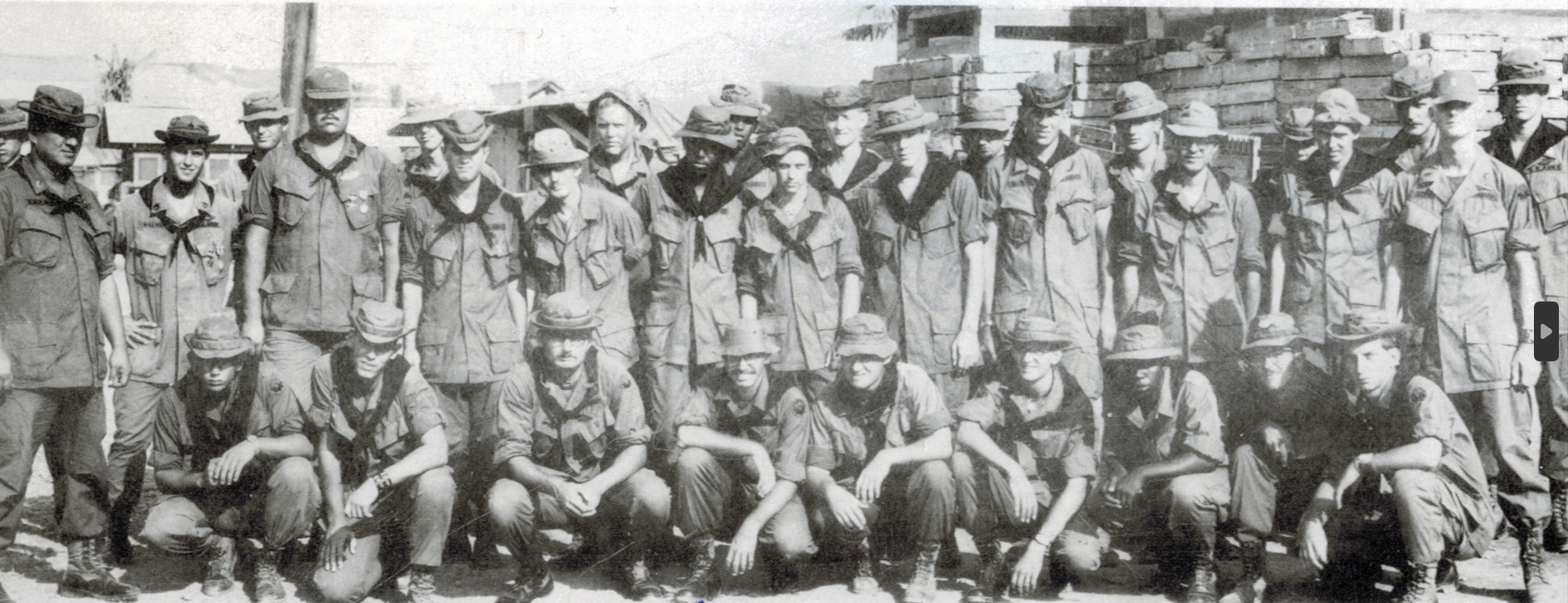
Picture

Left to Right
Front Row: Rivers, Jewell, Nelson, Jordan, ___, ___, ___, Litherland
Middle Row: 
Back Row: 
​

Thank you for visiting this website. You may be visiting this site as a family member of a veteran, a Vietnam veteran or as member of the public. I appreciate your interest in reading these stories. These stories take the third person point of view, thus the title “A Vietnam Soldiers Perspective”.
​
The American role in the Vietnam War lasted from 1955 to 1975. Over the years, more information of the Vietnam war has become available, and the general public has been able to learn more about this war. Perhaps one watershed moment for this information was the construction of the Vietnam Veterans Memorial Wall in Washington, D.C. The Memorial Wall was a catalyst that increased the public awareness of that war. The Wall and other high-profile books and movies made a difference among Vietnam veterans and their willingness to talk about that war.  

​The public has come to appreciate the contributions made by veterans of the Vietnam war. I hope these stories of my Vietnam experience will sharpen and heighten your appreciation for the contributions made by 2.7 million veterans who served in Vietnam and the 58,467 who served in Vietnam and made the ultimate sacrifice. I welcome your contributions of content and your response to these stories.

Thank you.

​Sincerely,
Norm Te Slaa

Story Index:
6. A Disease of Undetermined Origin
​5. The Long Silence
4. Stop it! Stop it! Stop it!
3. Squeak
​2. Road to Nowhere
1. ​Prologue to Vietnam
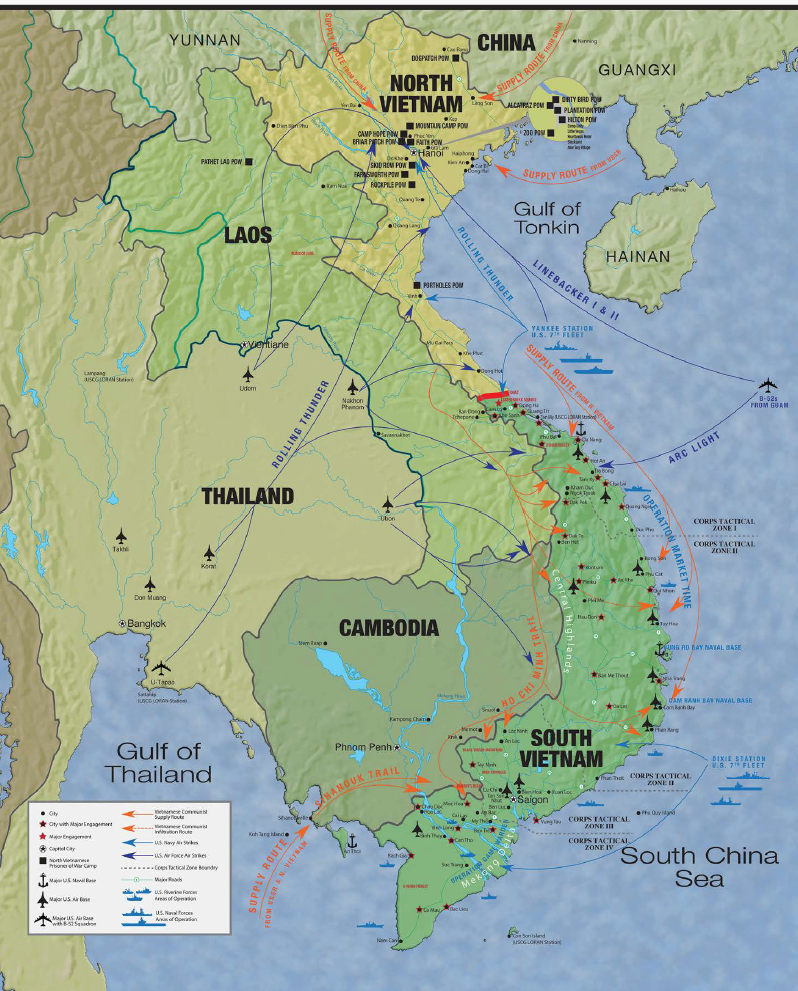
​A. Map of Southeast Asia during Vietnam War
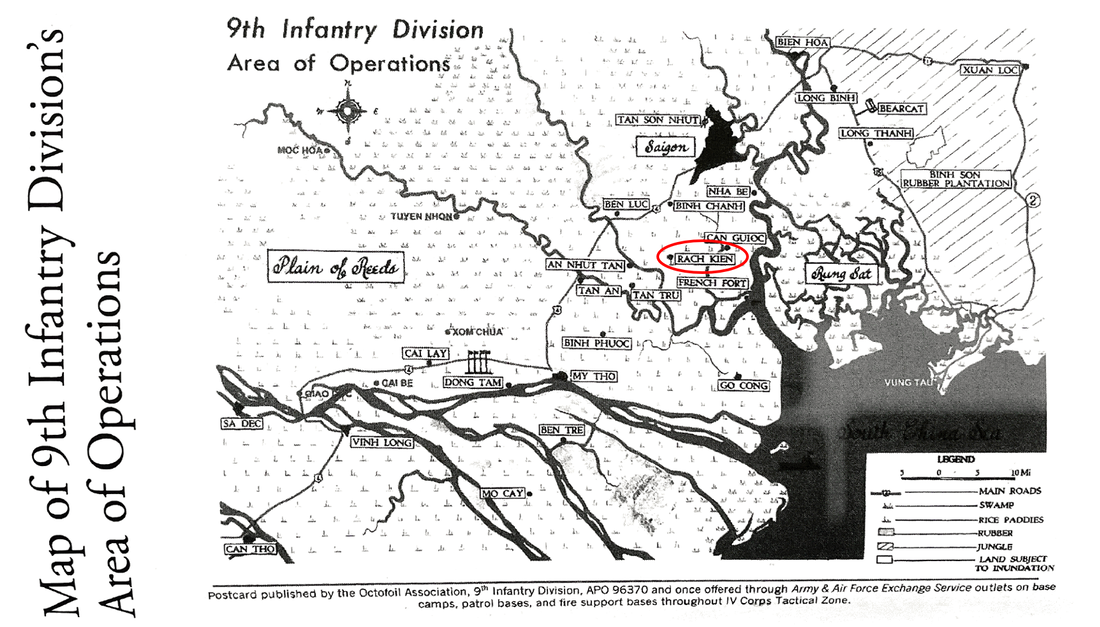
​B. 9th Infantry Division Area of Operations with Rach Kien


6. A Disease of Undetermined Origin

Picture
“Well, Spec. 4, you have a disease of undetermined origin.” It was an orderly at the army hospital in Saigon talking to the Spec. 4 soldier, newly awakened from unconsciousness.
 
“What do you mean, a disease of undetermined origin?” the patient asked warily.
 
“The doctor was unable to precisely diagnose the problem. The symptoms are similar to malaria, but they were not exactly like malaria. So in lieu of labeling the sickness as malaria, the doctor labelled it as a ‘disease of undetermined origin’.” explained the orderly.
 
The soldier slowly gathered his wits. He tried to reason out such a verdict. He could believe a diagnosis of malaria…but a disease of undetermined origin? He knew malaria was a common sickness in Vietnam. He had been very conscientious about putting two quinine tablets into his canteen drinking water, a requirement of all soldiers in the field.
 
He knew it was not a contagion like some GIs who experienced malaria-type symptoms. The orderly explained that there were several malaria-like diseases common in Vietnam among soldiers.
 
What was the orderly talking about that?
 
Was he talking about a sexually transmitted disease? Was he avoiding talking to him about subjects not normally discussed in polite company? Was he trying to save him from embarrassment…but he had nothing to be embarrassed about. There was no possibility he could have contracted ‘the clap’ as the GI’s referred to that class of diseases.
 
So, what could it be?
 
His mind began to review the mission of the past three or four days. He recalled Charlie Company had been in the field for several days. Their canteens had been empty for some time. Mosquitoes and blood suckers were plentiful but clean water was not. The company had been in and near several villages. He recalled he had bought sodas from a local Vietnamese mamasan.
 
He knew the company hadn’t been resupplied by helicopter, since the distinctive thump-thump of the helicopter blades, and the noise of the engine could alert the local VC or NVA to our presence in the area. He remembered waking up the morning of the third day, after laying all night in a defensive position on the inside of rice paddy dike. The rice paddy had been dry and the soil was hard as concrete, creased with large cracks. Their fixed defensive positions had allowed very little movement throughout the night. His body was stiff and sore. The platoon was exhausted from the daily strain of patrols and guard duty that everybody had to pull more than once during the night. There was no combat activity so far during the mission, but the platoons were edgy.
 
The platoons began to break camp. He noticed there was no energy in his body to prepare for the next mission.  He could not stand up. Platoon SSGT Kay observed his slowness, his incoherent speech and ashen, pasty-white face. He called Doc Martin, the medic, who came and took the soldier’s temperature. Doc Martin conferred with SSGT Kay and immediately called for a dust-off [1] for this nearly, unresponsive G.I. now going in and out of consciousness. Within minutes, there was a call to headquarters to medivac this soldier out of the field.
 
For evacuees from the field, there were no ‘good-luck’ or ‘good-byes’ from the platoon. He was just another soldier being taken out of the field. Some members of the platoon often expressed relief for an evacuated soldier without life-threatening injuries who was dusted off, secretly wishing it would have been one of them. They realized that now that evacuee might have a chance of escaping from combat with their lives and limbs intact.
 
After fifteen or twenty minutes the medivac helicopter arrived. The soldier came in and out of consciousness while his body and hands were being strapped to a stretcher. The basket-like stretcher was then tied to the skids on the outside of the helicopter. He looked up to see the underside of M60 machine gun muzzle above his feet.   
 
He felt no fear or anxiety of being strapped to the outside of the helicopter. It was normal on eagle flights [2] for platoon members to be sitting two or three abreast at the open door with their feet resting on the helicopter skids. Such a transport arrangement still left room for the M60 machine gunners on each side of the helicopter to maneuver and three riflemen on each side of helicopter to lay down a field of fire when landing in a hot LZ [3] .
 
He lost consciousness before the helicopter became airborne, and he didn’t regain it until the helicopter landed at Tan An, a field hospital in their area of operation. The medics took off his clothes and boots and stripped him naked. He was placed on a gurney and transported into the field hospital.
 
Inside the field hospital, and barely inside the main ward, was a large steel tank the size of a bathtub. The tank appeared to be filled with water. But water it was not! It was filled with ice-cold alcohol.
 
The orderlies slowly lowered him into the tank and submerged him from his toes to his chin until his entire body was enveloped by the icy alcohol, only his mouth escaped the shock.
 
His reintroduction to reality was immediate. He was shocked into temporary consciousness. He had no recall how long he stayed in this liquid deep freeze but probably only a matter of minutes. Whatever the time he spent in the alcohol bath, it may have been at least partially successful in getting his fever down from 107 degrees. He lost consciousness again after being taken out of the alcohol. He had no recollection of what happened after the Tan An alcohol bath.
 
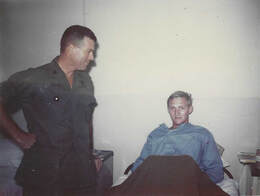
He awoke on some future day, perhaps a day or two, in the Army hospital in Saigon. At the foot of his bed was the battalion commander of the 5th Battalion of the 60th  Infantry.  (Photo in hospital) He was talking to the Spec. 4. It was his practice to visit all the hospitalized soldiers in his battalion.  
 
Wearily, the soldier greeted his commander. [4] He realized he was in a hospital ward surrounded by other sick or wounded GIs.  The commander spent a few minutes with him and then moved on to the next bed in the ward.
 
The Spec. 4 had no recollection of what was said between him and his battalion commander. But he did recall being grateful and impressed that he took the time to express his concern.
 
After four or five days in the Saigon Army hospital, he was released to return to his unit in Rach Kien. They issued him new combat fatigues and left it up to him to find his way back to the base camp. He caught a ride on the back of a deuce-and-a-half supply truck heading to his firebase, not unlike his first ride months before from Bien Hoa to Rach Kien.
 
He had no special memories of his return to base camp. He was just a guy who was being sent back to his unit to resume his duties as a soldier. There was no backslapping, no exuberant welcome-back greetings from his squad or platoon, just business as usual. Within two days, he was back in the field carrying radio for the lieutenant.
 
However, there is a bit of humor within this story.
 
Humor may be disguised in the form of mistaken identity. Mistaken, in the sense that if the disease was not malaria, then what was it? The answers are limited but the interpretations and assumptions could be many. The real cause of his sickness and the unanswered questions posed from his fellow GIs, and later his family and friends, he intentionally left open the answer for all manner of interpretations.
 
It became a source of speculation. Over the years, he watched the bemused, but doubtful responses of his listeners as he told the story. He noticed their sly smiles, their imperceptively-raised eyebrows, their suspicious looks, their winks, and retorts like, sure, who are you kidding?
 
A disease of undetermined origin? Really?


Footnotes:
[1] A dust-off was a helicopter who removed sick or injured soldiers and ferried to them to a field hospital.
[2] An eagle flight by helicopter quickly brought troops to a site for a potential engagement of the enemy
[3] A hot LZ was when the helicopters and troops landed under enemy fire.
[4] Photo taken of soldier by the battalion commander’s staff with the soldier’s commanding officer.
 
CONTRIBUTORS: Editor, Kim Van Es. Proofreader, Cathy Te Slaa, Web Master, Caesar Orosco


​​5. The Long Silence

Picture
I. The Long Silence
“Why should I remember what took many years to forget?” asked a Vietnam veteran.
For nearly thirty-five years, I rarely spoke about the Vietnam War with anyone. I found no compelling reason to talk about it. Exceptions to that silence were few—perhaps to answer a question from a friend or family member, or during an infrequent conversation about Vietnam with my wife. If I had to talk about it, more often than not, I would trivialize the experience. Bad times were really not that bad, or talking only about the good, the funny, or not-so-difficult times.

But there was no way I could control life events, and sometimes something happened that forced me to a recall an experience from Vietnam. These penetrations past my mental blockages came at surprising, unexpected moments, connecting me in some way to my time in the war—a hitchhiker trying to catch a ride on an approach to a highway, seeing a serviceman in uniform, or hearing the whoop-whoop of an Army helicopter overhead.

After returning from Vietnam, I wanted to move on with my life. My mind and my lips snapped shut on Vietnam. I had many reasons constricting my lips and closing my mind.
Most returning Vietnam veterans quickly learned that there was divided public opinion about the war. Even those veterans who were willing to talk about their experiences were reticent to breach the topic in conversation.

We were not welcomed as returning patriots or conquering heroes to America. A large segment of the population greeted us with silence, a deep distrust, and even disdain. As one Vietnam veteran put it, “The road home from war and the quiet that followed was sobering.” We were even shunned by veterans of prior wars. For many years after the war ended in 1975, the American Legion would not accept Vietnam veterans into their membership. They told us that Vietnam was never a real war and, by inference, we were not real soldiers.

Few people were interested in learning more or opening their perceptions of Vietnam. In that silence, my own recollections of Vietnam faded. It seemed easy to bury my recollections of the war into a vault to be forgotten and never opened again. My amnesia was self-inflicted.

But my silence around Vietnam was also self-preservation. It avoided questions like, “Did you ever kill anybody?” or “What was it like to shoot somebody?” “What was the worst thing that happened to you in Vietnam?”

I presumed that the people asking those questions had little interest in hearing the more important stories behind the headlines—the heartache of losing a brother to injury or death, the anger of obeying insane orders from a superior officer, the persistent feeling of loneliness and isolation. How does one explain the experience of living on an “island of war?”

To avoid the possibility of such conversations, I avoided the subject altogether. However, I’ve since learned from talking with fellow Vietnam veterans, that they too carried that same sort of reticence to relive their experiences. They—like me—were unsure whether they would be able to control themselves if those memories were awakened.

Perhaps there is a more truthful, personal answer to the question: Why was I so quiet about Vietnam for so long? Was I was afraid of awakening that sleeping monster along with its entourage of protégé monsters? Did I fear that retelling, rehashing, or rehearing about the Vietnam war would stir up emotions so overwhelming that I would not be able to control myself, and my emotions in turn would take control of me? I was paralyzed by the possibility that opening this Pandora’s box of the confusion and chaos of Vietnam would consume my existence.

I had no known physical wounds from Vietnam—unlike thousands of others who still suffer those consequences to this day. For them, there are daily conscious and subconscious reminders of Vietnam. The ever-present physical damage and emotional wounds left some brothers with thoughts of suicide. The scars incurred in Vietnam did not necessarily fade away.

I knew of other veterans whose lives had been so shattered by Vietnam that they had disintegrated into poorly functioning human beings. What if I would be no different? I had not yet been tested to know how I might react if I broke the long silence. I had consciously chosen to maintain my silence, that is, until my phone rang.

II. The Long Silence Lifts
The caller asked, “Is this the Norm Te Slaa who served with the 5th of the 60th Infantry Division of the 9th Division in Rach Kien, Vietnam?”

I fell silent for moment. After all these years, how could a voice suddenly emerge, seemingly out of nowhere, and ask about Vietnam? Was this a crank call or a sales pitch?
He sensed my reticence and quickly introduced himself. “Norm, this is Tony. We served together with the 5th of the 60th in Rach Kien.”

I quickly searched my dusty memories for his name. Yes, I remembered a Tony, but I barely knew him in Vietnam. That was not unusual, as we usually referred to each other by last names or some nickname the men had conjured up.

I vaguely recalled him. There was a day during my third month in the field when he had been walking point [1] and was injured by a booby trap. He was shipped back to the United States for hospitalization, recovery, and a purple heart. I had not heard from him or about him since then.

He continued, “Norm, have you heard that the 5th of the 60th has been having battalion reunions every other year for the last several years?” I hesitatingly answered that no, I had not heard about them. My conversation with Tony moved slowly, mainly because of my delayed responses to his comments and questions. I had a hard time understanding why he was calling to invite me to a reunion now. I was not prepared for such a call. In so many ways, it was the furthest thing from my mind.

Tony then invited me to attend the battalion reunion coming up in St. Louis in the spring of that year. As we talked, he told me more about the four previous reunions, and he mentioned that the special guest speaker at the next reunion would be one of the generals of our battalion during 1969, General Franks. His name also barely registered in my memory.

I was wary of attending and my doubts continued. After all, I could not remember many names from 1968 to 1969, only four or five came to mind, and these blank spaces in my memory concerned me. If I did attend, how could I even carry on a good conversation with the others? I was even unsure of my assigned platoon and squad number. And yet, my memory of certain events during that year could still be played back in technicolor.
Did I want to continue this conversation? If I did continue, would my confusion and feelings of chaos around my memories of Vietnam come crashing in, destroying my quiet life and successful career?


But slowly, I relaxed, and my reticence eased. I shifted from shielded to inquisitive, and I began to ask questions. The conversation began to feel more normal, even as my doubts about attending this reunion continued to bubble up.

My first impulse was to say no to the invitation. But hesitantly, I said I would think about it. I needed time to deliberate whether I wanted to let Vietnam back into my life. Sometime later, I called Tony back and told him, yes, I would come. But my doubts and apprehensions lingered.

Yet, I knew I needed to give my long silence a trial termination.

III. The Long Silence Ends
I attended my first reunion in the spring of 2012. Remembering Vietnam was initially very difficult; I could only recall a few names and places associated with Vietnam. But beginning with my first reunion, connections with my Vietnam past began to emerge.
I found myself among veterans who were not only willing to talk about Vietnam—they wanted to. We felt an immediate understanding and comradery among us. It was my first recollection of another Vietnam veteran calling me ‘brother’.

I soon learned that the 5th of the 60th reunion was an emotionally safe place. For many, the reunion was an act of self-preservation—finding a space where others understood them, also carrying similar questions, doubts, and apprehensions. At the reunion, veterans were ready to talk about Vietnam.

All around us were reminders of the physical damage. Some brothers lived every day with the tangible legacy of their Vietnam service. The manifestations of psychological damage, however, was less noticeable, at least initially.

I was relieved that others were also surprised at how little they recalled about details of daily existence in Vietnam. They, too, were hesitant to relive their experiences and had participated in their own ‘long silence.’ Fellow veterans said things like, “I don’t remember that.” or “What was his name?” or “Did we do that?”

I also learned that every Vietnam veteran had experienced a different version of Vietnam. Understanding these differences of experiences began with a soldier’s Military Occupational Service—their MOS. [2] I had been ground infantry, the MOS designation for which was 11B.

Approximately 2.7 million American men and women served in the Vietnam War, and for each 11B soldier in the field, it took eight or nine soldiers in the rear to support them. That breadth of different duties help account for the wide spectrum of interpretations of the Vietnam soldier’s experience.

Some of those 11B soldiers who had witnessed and participated in combat and bloodshed were left with emotional wounds. They returned home only to be swallowed up in their own quiet, psychological quagmire that filled their lives with trauma. And for the soldiers returning with lifelong physical damage, there was no escape from the daily reminder of their Vietnam service.

Few soldiers ever aired their emotional wounds. Some waited for years before allowing their Vietnam memories back into their thoughts. But some veterans seized the opportunity to unload their burdens at battalion reunions.

At a reunion of a battalion of grunts, among fellow, trusted brothers, veterans did not need to be as cautious as they talked about their memories and traumas. I saw this at my first battalion reunion. One brother’s expression of his trauma still replays vividly in my memory.

On the first day of my first reunion, Tony and I were walking down the hotel hallway, passing rooms with different gatherings of brothers, usually grouped by platoon. These gatherings were called ‘talk backs’ when brothers could meet with their squad or platoon and just talk about what was on their mind or reminisce together. Each room’s door was open, welcoming any latecomers.

We were talking as we passed by the third door when Tony suddenly grabbed my arm, stopping us. He shushed me and said, “Please be quiet! One of the guys is spilling his guts.”

Silently from the hallway we observed a brother sharing his trauma with his platoon. He was sobbing and in obvious distress. Neither of us heard what he was saying, but we could feel that it was an emotional avalanche. We were witnessing decades of emotional pressure being released.

For me, not being in the room, I feared we were betraying the confidence of our brother inside the room. After all, we were eavesdropping at a moment when he was finally able to bare his soul among his comrades and confidants, each of whom listened with understanding, compassion, and without judgement. Did I have the right to observe such a personal expression without his permission? The sight brought tears to my eyes. I could only imagine his sadness, his long-endured pain, and the endless sleepless nights he had suffered.

Tony and I moved on down the hallway, hoping the dark cloud enveloping this brother might now lift. To this day, when I think of him—and so many others—carrying such suffering, I find it hard to hold back my own tears.

This moment from my first reunion—and many more like it—is a testament to the fact that the emotional scars from Vietnam don’t necessarily melt away. The wounds of war can mark us indefinitely. These daily reminders of the Vietnam trauma—both conscious and subconscious—pick at the scabs of our memories.

At the age of twenty-three, I was one of the older grunts in my platoon. My maturity may have been one of the reasons why I sustained fewer traumas than some of my teenaged platoon brothers. The other reason being that my main field time job was as a radio operator, in addition to being a rifleman.

My main job was to carry the radio for the platoon leader, usually a second lieutenant. The two of us were usually in the middle of a line formation. My job was to have the field radio immediately available for the platoon leader so he could maintain contact with other platoons of the company or headquarters company.
 
Because of my radio responsibilities, I was also never tasked to carry an injured or deceased brother to a medivac helicopter. I never had to bind up the wounds of a booby trap or gunshot victim. That’s not to say I didn’t see them happen. I did. But for the most part, I was spared some of the severity of that trauma. Others who carried our brothers and bound their physical wounds, went on to carry their own emotional wounds throughout their lives. I am eternally grateful to my brothers, and especially our medics, who bore the responsibility of taking care of our injured and fallen soldiers.

Now, many years later, I still need to come to terms with certain subjects. A tear might unexpectedly appear when certain subjects come up. When that happens, my face freezes, my lips purse, and my mouth closes tightly, I swallow hard as I try to hold my emotions captive and avoid embarrassment.

After more than a decade of unpeeling the protective layers of silence, I began to see how close to the surface my own emotions actually are. I won’t go into detail here, but two very public events happened relatively recently that poked that slumbering monster within me. During each, I was asked to recall an experience, and doing so forced me to confront the fact that the pain of some events was still fresh within me.

I don’t regret what I did in Vietnam. I did as I was told. I also prayed a lot. I smoked packs of cigarettes every day, and I tried to stay close to my moral anchors. I did what I could to protect my brothers, and I took control of situations when I could to shield others from further harm. I am not ashamed of anything I did during my time in Vietnam. This alone helps me sleep peacefully.

So, why do I now write about something that happened so long ago?

First, I write because the remembrance of the Vietnam War is fast fading from the American conversation. Today, the people who might understand or even care about a living soldier’s story of his Vietnam War, and the people who walked those roads and rice paddies, manned and survived the ambushes, rode innumerable eagle flights, and walked miles and miles of search and destroy missions, are dying away. Soon, the Vietnam War will be only a footnote in history.

Second, I write because I cannot forget or ignore the sacrifices made by the 56,478 soldiers who gave their lives, and the over 300,000 soldiers physically injured—and even more emotionally wounded—in service of our nation’s call to duty. How can I remain silent in the face of their absent limbs, fractured minds, and muffled voices from the grave? Staying silent only increases the injustice of their sacrifice.

Third, I write to remind the public that there are people living among us who agreed to risk their lives for our country. Why should I not do what I can to honor their commitment to serve and face the danger of dying in war?

And finally, I write because many veterans have come to understand that none of us can keep our Vietnam combat experiences silent and locked away. If we ignore what happened in Vietnam, we do so at our own peril.

Until recently, I felt that wearing a Vietnam veteran cap was a distraction. But I no longer feel that way. Quite the opposite. Now, wearing this cap reminds me and others who see the cap’s insignia that there was such a momentous American event called the Vietnam War. It involved not only the people who served in the military. It touched and affected all of America. It tore our society apart.

Many Americans and Vietnamese died. Many more were injured. Some recovered from their injuries, but many did not. Wearing a reminder of the Vietnam War speaks to the sacrifices and the price that thousands of American soldiers paid, and continue to pay today. And we speak to break the long silence that holds us captive.

Why shouldn’t we remember what it took many years to forget?


Footnotes:
[1] A soldier walking point was the first in a line of soldiers during a field operation. Often, the point man led the column of soldiers along a single path or dike. These were the likely places where booby traps, grenades, ‘bouncing Bettys’ and enemy soldiers might be first encountered.
[2] Military Occupational Service.


CONTRIBUTORS: Cathy Te Slaa, proof reader, Caesar Orosco, Web Master and proof reader,  Tony Sparaco, Vietnam Veteran, Josephine Moore, Editor.
​
Reader comments:
Response to The Long Silence
              Reading The Long Silence was, for me, like my brother was speaking to me from the grave. He was a U.S. Army Vietnam veteran and passed away on October 15, 2019 at the age of 75.
              He was always a man of few words and even more so after coming back from Vietnam. He never talked about it except for one incident. That was when I asked him what he was doing on his birthday on Feb. 12, 1968. I had a dream that night that he was in a foxhole and I was with him. There was water in the bottom and my feet were very cold. There were rockets or gunfire or something “fire” overhead. That is all I remembered of the dream.
              He looked surprised and said that is exactly what was happening on his birthday.
              He had health issues after returning but would never see a doctor. He and his wife have one son who is now grown and has children of his own. But his wife had several miscarriages and they had one full term baby girl who was born with numerous deformities. She lived for 10 days. So he was haunted by Vietnam until he died but never spoke about it.
              He is buried next to his baby daughter. 
-Arlene S. 


​

4. Stop it!  Stop it!  Stop it! 

Picture
One of the few missions that platoons and companies assigned to fight in the Vietnamese Delta looked forward to—if the grunts looked forward to anything—was providing additional firepower to the Mobile Riverine Force. A Navy concoction created for the unique demands of fighting in a waterlogged Mekong Delta, the Riverines patrolled all the waterways, large and small, of the Vietnam Delta. 

Their boats were modest in size, about thirty feet long and twelve to fifteen feet wide, with lots of thick steel.  They typically traveled in caravans of four or five boats. The Army offered additional security, firepower for the Riverines and the flexibility to pursue the enemy.  The Navy in return provided the Army grunts with regular hot meals and clean bunks for a few days.

Together, they sought out the Viet Cong and the North Vietnamese Army Regulars among the many rivers and tributaries of the Mekong Delta. If sightings or battalion intelligence spotted enemy activity, the Riverines and the Army grunts would engage the enemy from the boats. After the firing was over, the grunts would slog ashore through mud and water, try find and engage the enemy again, then return to the boats. 

The Riverine boats bristled with firepower. The centerpiece of the firepower was a 50-caliber machine gun mounted on the bow of the boat. When attacked, the 50-caliber machine gun and the grunts riding “shotgun” were the first to engage the enemy. 

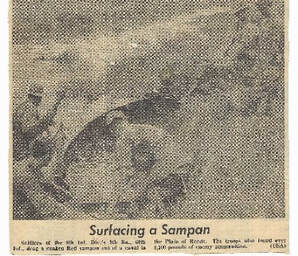
As the Riverine boats patrolled the water conduits linked to the Ho Chi Minh trail that the enemy used for moving supplies from North Vietnam, the soldiers remained alert, always looking for suspect sampans carrying supplies deeper into the Delta. The VC and the NVA often transported weapons and supplies under the cover of darkness. If daylight came before the sampan cargo reached its destination, the enemy submerged the sampans in offshoots of a larger stream, with the muddy waters of the delta camouflaging the sunken sampans. Occasionally, patrols and the Riverines spotted them as the boats crossed streams, with the grunts looking carefully into the murky water.

Picture
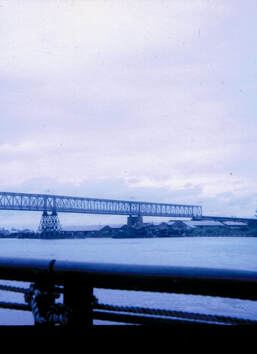
One day, the boats patrolled the Mekong River near the Ben Luc Bridge, a quarter-mile long bridge that served as the main thoroughfare between two South Vietnamese provinces. The Navy Riverine boats often guarded the middle of the bridge while both ends of the bridge were guarded by the Army, a light-duty assignment most grunts appreciated.

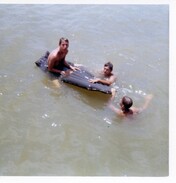
But there was also boredom on the Riverine missions. On this particular quiet afternoon, some grunts had stripped naked and had jumped from the moored gunboat into the river for a swim.  Other soldiers had gathered about the 50-caliber machine gun and the platoon sergeant.


Picture
Then, without warning, the clatter of the machine gun cut through the calm, erupting with bursts of fire. Soldiers in the water frantically swam back to the boat believing the machine gun operator had spotted the enemy and had opened fired on them.
The startled grunts on the boat immediately reached for their weapons. A Specialist 4 in the back of the boat grabbed his M16. He looked at the platoon squad leader seated behind the 50-caliber machine gun and the small group gathered around it. The squad leader was behind the machine gun, his hand on the trigger, firing intermittent bursts of fifteen or twenty rounds each. The few soldiers around him were not alarmed and not acting as if they were under attack. 

The platoon quickly realized there was no ambush. For amusement, the platoon sergeant was using the Ben Luc Bridge, which stood about a click [1] away, for target practice! About every fifth round was a tracer round, giving off visible streaks so everyone could see what was targeted. 

The bridge bustled with many people on foot, some riding bikes and others driving motorized vehicles. Not one was a threat to the Riverines and the grunts. The only threat was the soldiers, endangering the civilians travelling across the bridge.

Horrified, the Specialist 4 shouted from the back of the gunboat, “STOP IT!” The E6 sergeant ignored the lesser-rank soldier. After another burst of fire, the Specialist 4 yelled louder to the platoon sergeant, “Stop It!”. After another burst of fire, the Specialist 4 shouted a third time “STOP IT!” and the E6 sergeant exploded. He jumped up and stormed to the back of the boat, fuming with rage that this lowly Specialist 4 would challenge his own platoon sergeant. The sergeant drew from his hip holster a long-barreled, 8mm pistol, raising it as he approached the Specialist 4.
 
Without flinching, the soldier stood his ground.

The sergeant thrust the pistol under the soldier’s jaw and into the softness of his throat. Addressing the Specialist 4 by name, he raged, “You mother fucker! I’m gonna blow your fuckin’ head off!”  as he pushed the pistol harder into the Specialist 4’s throat.

 “What are you doing, Sergeant?” the Specialist 4 asked. “They’re innocent civilians!” 

Soldiers in the back of the boat contested the sergeant’s bad behavior and tried to calm him. After about twenty seconds—but seemed like minutes—he lowered his pistol and, fuming and cursing, walked back to the front of the boat. 

The Specialist 4 stood surprised, saddened, angered, and shaken. The situation had been highly precarious. “How could such an event occur among fellow soldiers?” he thought. “We’re here to fight Viet Cong and the North Vietnamese Army, not each other.”

He could only make sense of it because he already knew war could expose some of the darkest sides of our humanity. But most of the brothers in combat—thank goodness—held firm to their civility and never lost sight of our common humanity. 

 
Footnotes:

[1] A ‘click’ was approximately a kilometer. It was used as a measurement of distance that could easily be heard over a radio transmission. 

​CONTRIBUTORS: Caesar Orosco, Web Master; Josie Moore, Editor

​1.  2nd platoon ready for a swim                         2.  Mobile Riverines on patrol


​
​3. Squeak

Picture
 INTRO TO SQUEAK:  The subject of this story happened occasionally while on field missions. This one was for me, also affirmed by another brother, as one of such events that stands out among others like it. Hope you enjoy the story.
 

It was a normal ‘search and destroy’ mission that began sometime during the Vietnamese dry season.[1] Charlie Company, of the 5th Battalion of the 60th Infantry, was preparing for a field operation that would be a considerable distance from the Rach Kien base camp. Staff Sergeant Kay told the men to pack all the ammunition they could carry. This more-distant-than-normal mission might last three or more days. Although food and ammunition were usually resupplied to the field troops by helicopter, it didn’t always happen.

The troops in Charlie Company gathered for the five UH-1 helicopters that would pick them up on the gravel road outside of the firebase. Once they were in the air, the ride to the target area took about fifteen minutes, landing the platoon in a cold LZ[2].

For the next two days, they made no daytime or nighttime enemy contact. Near the end of the second day of the mission, the platoon was getting low on food and water. The GIs realized that the helicopter would not be returning to supply them with canned food and water, since no enemy contact was reported to battalion headquarters, and the ammunition of Charlie Company was still in full supply.

With food and water diminishing and hunger and thirst mounting, the grunts had few alternatives. It was not the first time they would need to scavenge for food and water, and their only choice was to seek sustenance from the local Vietnamese villagers.
By late afternoon of the second day, the men began walking to a nearby village. There were seven or eight hooches in a nearby village where local mama-sans were preparing a butchered chicken or duck that surrounded their hooches. Because each hooch could accommodate, at most, five or six people, the platoon broke up into squads and approached different hooches, asking for food.

A squad leader approached the opening to a hooch that contained a mama-san and two small children inside: there was no papa-san in sight. The squad leader poked his head inside, noticed a large black pot over and open fire and blurted out the only Vietnamese words he knew: “Hey, Mama-san! Chop-chop?” as he circled his hand over his belly and, gestured with imaginary chop sticks, scooping food into his mouth.

A squad member reached around the squad leader, addressing the congenial mama-san with the same question: “Mama-san, chop-chop?” he said as he circled his hand over his belly and, with the other hand, motioned as if scooping food into his mouth. Mama-san immediately knew what they were asking. Perhaps, she had previously met other GIs with similar requests and motions.

With a friendly smile and a welcoming gesture, she invited the six hungry soldiers into her doorless hooch. The dirt floor was hard, worn smooth and almost shiny by family traffic and sweeping; a straw broom leaned against a nearby wall. The mama-san was making the evening meal for herself and her children. Whiffs of rice and meat cooking mingled with the pungent smell of the burning rice straw and nippa palm wood under the pot, smells the GIs had encountered many times before.

The soldiers sat down in a half-circle with their legs crossed and facing the large black pot. The mama-san set about adjusting her ingredients to accommodate what would now include six unexpected, hungry soldiers.

Within minutes the mama-san passed out earthenware bowls and chop sticks to each of the soldiers. She went around the room spooning a large portion of rice on each of the plates held out by outstretched American hands. Etiquette and good manners took a back seat to hunger as the GIs began to eat the moment their bowls were filled with rice.
The mama-san returned to the black pot, and with the kettle in one hand and a ladle in the other, she went around the hooch, giving her surprise guests a small portion of perfectly cooked meat and juice on top of their remaining rice.

The soldiers expressed their gratitude to the mama-san. They knew what it meant that the mama-san was willing to share a meal of such value with total strangers. The free-range chickens and ducks from her yard, and the fish from a nearby rice paddy or delta stream, were valuable to her and her family.

She smiled at the Americans’ enthusiasm as they ate her Vietnamese food. The hungry soldiers muttered their approvals with complimentary grunts of “hmm” and “Hey, that’s good” as they eagerly gulped down the cooked meat and beautifully cooked rice on their plates. The mama-san seemed to have added some spices to the otherwise bland meat and rice.

The meat was especially tasty. The pieces were of different sizes and shapes, all mostly small. They were light in color, tasting and looking like chicken bits but with a slight tinge of yellow. The texture was also different - it was a uniform texture but had granule-like sparkles as though the meat had crystalized.

The radioman addressed the mama-san between bites of food: “Mama-san, number-one chop-chop!” as he rubbed his stomach and motioned with his chopsticks to the food on his plate. Others chimed in or nodded their agreement. He asked mama-san a question: “Mama-san, Chicken? Duck"?

She looked puzzled as the GI asked his question. It was obvious she did not understand. The GI asked a more specific question: “Mama-san, number-one, chop-chop. Chicken? Duck?” He pointed to the chickens and ducks outside of the hooch and then the meat on his plate.

Now she understood what he was asking!

A smile quickly crossed her face, and she threw her head back with a little laugh. She responded with another Vietnamese word that none of the GIs could understand. She looked at the puzzled GIs as if to say, Why don't they understand?

 Finally, she stood up from her haunches and moved to the edge of the hooch.
​

With her knees bent and leaning forward, she reached out to the edge of the hooch, put her hand at the very bottom of the wall, and used her two fingers in imitation of a fast-running figure. She took small steps while her two fingers acted out a fast, imaginary walk along the bottom edge of the hooch, repeatedly saying in a high-pitched voice “Squeak, squeak.” “Squeak, squeak.” “Squeak, squeak.”

She then turned and smiled at the soldiers sitting on her floor, confident they would now understand about the meat on their plates.

Her “dinner party” guests looked at each other, then looked down at what remained of their meal of meat and rice.

They were silent. They looked back at each other in disbelief!

They had just eaten their first boiled rat!
 
​

Footnotes:
[1] Dry season was from November to April
[2] A cold LZ was a landing zone without incoming enemy fire. 


Contributors: Cathy Te Slaa, proofreader, Josephine Moore, Editor

Reader comments:
"We must have been in different hootches.  Mine was chicken and rice and we all chipped in two dollars worth of P each."  -Bob L.


​
​2. Road to Nowhere

Picture
It had been a long day of processing out of the US Army holding company in Bien Hoa, South Vietnam. New in-country recruits had become somewhat accustomed to the ten or so days of pulling perimeter guard duty. Guarding the perimeter was the most frequent assignment for those soldiers processing into Vietnam while waiting for their duty assignments. Walking back and forth between the guard towers, perimeter guards had created a well-worn path on the inside of the perimeter fence over many days and months.
 
The perimeter fence surrounded the massive Bien Hoa base. The fence itself was made of miles of eight-foot-tall chain-link fence. Stacked atop it was quadruple coils of shiny razor wire. Between the stretches of steel fencing and razor wire, at spacings of three hundred feet, stood twenty-foot-tall guard towers with 360-degree views of the area.
Outside the perimeter fence and razor wire, concealed among the brush, weeds, and small bushes, were dozens of Claymore mines, each with a trip wire leading back to the inside of the perimeter fence.[1] Claymores were arch-shaped, with hundreds of steel pellets backed up by a row of C4 that, when triggered, tore anything within fifty feet into small pieces. They were intended to obliterate enemy sappers.[2]

Sappers were enemy combatants who regularly tried to penetrate the perimeter by throwing satchels of explosive charges over the fence in an attempt to breach it.
 
Sappers would get close enough to the firebase perimeter enabling them to blast holes in the perimeter fence or attack nearby equipment and buildings. Perimeter guards learned soon enough that the Claymore mines were deadly, effective defensive weapons against the sappers, and animals that might wander into the range of the Claymore.
 
Another frequent but safer job than perimeter guard duty for new recruits awaiting field assignments was the “shit burning” detail. Under the latrines were steel barrels that had been cut in half. Those on shit-burning detail pulled those out, doused the human waste with diesel fuel, and set them on fire. The recruits had to stir the waste as the fuel burned down and keep adding more fuel until the waste was reduced to ashes.
 
All new arrivals had assignments inside the heavily guarded perimeter fence. During their in-processing time, they lived in barracks, ate hot mess hall food, had time off, and lived within the relative protection of the perimeter fence.
 
Finally, after several days, the new arrivals received their combat unit assignments. By now, these soldiers’ suspicions of being sent to a combat unit were being confirmed. Although they did not know where they were being assigned, they knew they would be replacing soldiers whose DEROS[3] date had arrived or were leaving the country because they had been hospitalized, injured, or killed.
 
The final day-long “hurry up and wait” was coming to an end and loading onto the trucks was about to begin. These newly minted American GI replacements were issued M-16 rifles with live ammunition.
 
Suddenly the sergeant’s gruff commanding voice would cut through the silence: “Load up!” The soldiers quickly snapped to attention, confirming their simmering anxiety.
 
The sergeant’s abrasive voice demanded obedience. It was a voice with the same crassness the soldiers had heard from their drill sergeants during their sixteen weeks of basic and advanced infantry training. Once again, those threats from the drill sergeants echoed in their thoughts: Listen up, you meatheads! If you don’t do what I tell you, you’re gonna’ die in Vietnam! At the time, they smirked at such a thought. Such a preposterous warning was for the other guy, but not for me!
 
Quietly and quickly, they mounted the Deuce-and-a-Half,[4] taking places next to other soldiers they had never met. Five or six soldiers sat facing inward on wooden benches along each side of the open-air truck. Another three soldiers sat with their backs to the cab and rode backward. None of them knew anything about this ride to nowhere. They were about to find out!
 
There was a quiet, simmering apprehension among the soldiers, most of them barely out of—or still in—their teen years. They all looked the same in their clean, bloused fatigues and polished jungle boots. These new, in-country soldiers looked like blank copies of each other. Their expressionless faces gave no indication of what they were thinking or any reading of their personalities. None of them knew anything about the others and perhaps didn’t even care. They were enclosed in a world unto themselves. They were breathing, yet they were people without personalities. There was no backslapping, no bravado. Only an occasional comment or quip of attempted humor broke the silence momentarily. Their faces remained stoic and their bodies rigid.

Only months earlier, some of these boys had walked across the school gymnasium stage to accept their high school diplomas. There were a few that seemed to be in their early to mid-twenties. They could have just completed their college bachelor’s or master’s degrees. There were others seemingly old enough to have been pulled from their jobs when their draft number came up.
 
The edgy GI truck driver had fussed about the truck’s road worthiness. He nervously walked around the large truck, kicking the tires, checking the lights, and pushing here and there on the mirrors and latches of the truck, barely noticing the soldiers in the truck bed. He seemed to have no expectations that the new grunts would have any value in providing security, even with live ammunition in their rifle magazines. Instead, riding shotgun for the driver and the recruits was a seasoned E6 sergeant equipped in full combat gear, including helmet, flak jacket, and bandoliers of M16 ammunition slung over his shoulder. In his arms and holding with both hands in the ready position was an M-16 rifle in safety position. An M-40 cannon lay on the seat between him and the driver.
 
It was a trip this truck-driving duet had taken many times before. They knew their sole mission well. It was to get on the road on time and see that their human replacement cargo would get to their destination safely and without the distraction of an enemy encounter along the way.
 
The driver started the noisy, growling engine and scratched the olive-drab diesel truck into low gear. Clouds of black smoke belched out of its two large front exhaust pipes, covering the soldiers with billows of diesel exhaust. The truck lurched forward and on to the paved street of Bien Hoa. It seemed obvious to the grunts[5] riding in the truck bed that the driver was in a hurry.
 
The truck driver knew something that the grunts did not know—but they now began to sense his urgency. The trip needed to be completed by sundown. He knew the ride would be bumpy and fast. Ruts and curves in the road be dammed! Time was evaporating!
 
It was only a matter of minutes before the truck passed through the perimeter gate, and then the gate of Bien Hoa closed behind them. Now they were on the outside of the base perimeter. They had spent several days looking at this perimeter fence from the inside, within its relative security. It was the first time since landing in Vietnam that they held no defensive positions between them and the enemy.
 
They passed the fifteen-foot-high square guard towers where multiple M-60 machine guns menacingly pointed out into no-man’s land. The stacks of razor-sharp concertino wire caught flashes of the reflected setting sunlight as the base faded into the distance. Fading from their sight were the guard towers, the well-worn paths on the inside of the perimeter fence they had patrolled for many days and nights, and the six-inch high, convex Claymore mines. A dream-like surrealism took hold as the Vietnamese countryside enveloped them.
 
Instinctively, there was a sense that the enemy could be—and probably was—anywhere and everywhere around them. They were in the territory of the Vietcong and the NVA.[6] The clumsy truck and its truckload of soldiers were lost in a cloud of dust as they sped toward the setting sun.
 
The narrow road wound through the Vietnam countryside, measuring only fifteen or twenty feet at its widest. The horizon in all directions was only broken by patches of nipa palm trees,[7] rice paddies, and a few hooches.[8]
 
They were on their way to an unknown place, a place with no name, a road to nowhere!
 
The miles piled up as they passed hundreds of small hooches, some with rusty tin roofs and others with roofs and sides of thatched, dried nipa palm leaves. As they raced past the hooches, they could catch fleeting glances of lamps and cooking fires through their open doorways.
 
The rice paddies on either side of the road were empty of anything that might resemble American farming equipment. Occasionally they would pass a local, aging farmer guiding a single- or a double-yoked water buffalo toward home, which would be surrounded by small flocks of chickens and geese looking for food and security near its open door.
 
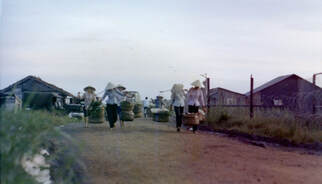
The road was busy with local villagers walking or riding their mopeds stacked high with boxes and bags, traveling home from markets in nearby villages. The Vietnamese walking on the side of the road were mostly women. They wore white silk-like surplices over black, flimsy trousers. Stretched over their shoulders were four-inch-wide and six-foot-long yokes without any cut-outs for their necks. The bamboo yokes extended a couple of feet beyond their shoulders. The yokes seemed alive, dancing as they flexed and up and down in tempo with their carriers’ fast, short, measured steps. Even without the heavy weight of the near-empty sacks, the pliable shoulder yokes moved up and down in a subdivided rhythm.
 
Sometimes a soldier would make a comment, yelling over the noise of the truck, about the smell of the countryside or a derisive comment about one of the locals on the road. It was an effort to break the tension, but it only served as a distraction to mask the soldier’s own fears.
 
Otherwise, a stoney silence settled among the soldiers. No one wanted to expose the fear written on their faces by talking. Their silence belied the anxiety they were all feeling. Perhaps it was their unbelief of finding themselves in such a foreign, other-worldly, dangerous landscape. Perhaps they were thinking that their drill sergeant’s warnings might contain some element of truth for them after all. Maybe it was simply that no one wanted to talk over the noisy diesel engine.
 
In the waning daylight the soldiers could see countless squares and rectangular-patterned rice paddies and interspersed among them were clumps of nipa palm groves.
 
The troops’ attention now returned to the fast-moving truck, dodging ruts and potholes, pedestrians, mopeds and bicycles. The driver seemed acutely aware of how many more minutes it would take to reach the firebase before dark. He repeatedly glanced at the setting sun. His nervous, calculated glances confirmed to him that darkness was minutes, not hours away. He wanted to avoid a night encounter with the enemy at all costs.
 
The hurrying driver’s mission was to get his cargo of newly minted soldier replacements to their destination without an enemy encounter, so he seemed not to notice the busy pedestrians traveling along the narrow road. For most of the trip, the road was not wide enough for two trucks to meet. When two vehicles did meet, one would have to find a place to slow down or stop and pull to the side of the road to let the other pass. There was no large local truck traffic on the road, only mopeds, some stacked high with boxes, as well as fast-stepping pedestrians and bike riders.
 
The truck driver had obviously driven this road many times before. He was quick to swerve out of the way of potholes and oncoming traffic, only slowing down or speeding up as the road and congestion allowed. But there were other reasons, less obvious to his human cargo, why this driver seemed like a crazy man.
 
Anyone on any road in the South Vietnamese delta in the dark was an open invitation to serious trouble. The driver was keenly aware of the approaching darkness, as it exponentially increased the likelihood of becoming a “sitting duck” for an enemy mortar or a Viet Cong ambush. Any slowing or stopping of any vehicle on any public Vietnamese road at night would be an easy target for an enemy, especially a truck carrying a load of American troops. Nobody wanted to be on any public Vietnamese road after the setting of the sun.
 
The truck driver flattened the accelerator to an even faster speed, dodging potholes and avoiding the scurrying locals returning from the market to their dirt-floor, thatched homes. In the early morning of that day, they had walked in the opposite direction, anxious to get their produce of vegetables and grains, live ducks and chickens to the market.
 
The traffic on the road seemed to increase, but now the truck was moving with the pedestrian flow. These locals were heading home from their day at the markets. The grunts guessed they were coming close to a small village. With the setting sun, it was becoming obvious to them that this road to nowhere might soon deposit them somewhere on a countryside surrounded by rice paddies, hooches, and nipa palm trees.
 
Soon the sun escaped over the horizon. The waning light caught the grunts’ attention. Apprehension heightened. The shadows and outlines of nipa groves and hooches were quickly losing their definition. Soon it would be totally dark.
 
The driver pressed the clumsy truck to an even faster pace. His almost reckless driving validated the soldiers’ awareness that total darkness was only minutes away. Their attention sharpened. Nobody spoke. Would they make it to their base soon?
 
Suddenly, with shock and surprise, the soldiers heard two muffled explosions, followed seconds later by two poofs of sound two hundred feet in the air above them. The sky exploded with light. All eyes were now on the white-light flares, illuminating a large area around them and reflecting off the silvery, shiny razor-wire perimeter of a nearby firebase, much like the sunlight that had reflected off the razor wire of the Bien Hoa base two hours earlier. They were coming to a firebase.[9]
 
The nearby firebase mortar platoon had fired off two precautionary flares, lighting up the area like daylight. Pulsating surges of light cast long shadows that seemed to dance in the darkness as the flares lost altitude and drifted to the earth. The mortars left trails of white smoke on their downward trajectory. Within minutes, the area surrounding the Deuce-and-a-Half and the firebase was again cloaked in near darkness.
 
Cautiously, short conversations started among the troops. They realized they had made it safely to a firebase next to a small village. Their spirits lightened. Relief spread across their faces. Their two-hour jostling, bruising journey was finally coming to an end.
 
The truck began to slow. Perhaps this ride on a road to nowhere was ending somewhere! The driver let up again on the accelerator and began a left turn into the hooch-like firebase. The soldiers in the truck were now standing, attempting to understand what was happening. On the left was a guard tower, standing like a twelve-foot ghostly centurion in the shadowed darkness. The lower four or five feet of the tower was stacked with sandbags that supported a wooden structure with a metal roof. Machine-gun muzzles poked out in three directions from the lookout.
 
The sweep of the truck’s headlights illuminated a hooch to the right front. It was a thatched home that seemingly at one time belonged to the village but had been commandeered by the army as part of the firebase. The headlights then exposed an abandoned rice paddy that neglect had reverted into a swamp. Rows of raised wooden planks over the swamp led to a doorless outhouse hanging over the swamp.
 
On the left and immediately next to the guard tower was an orderly room with a sign in the front. On the opposite side of the road was a twelve-foot-high and thirty-foot-long structure, stacked high with dirt-filled ammunition boxes. Covering this bunker was a metal corrugated roof.
 
The engine purred as the truck moved slowly down the single road through the firebase. The truck and its grunts passed Bravo Company on the right and Alpha Company on the left. It stopped midway down the road in front of a sign declaring, Headquarters, 5th Battalion, 60th Infantry, 9th Infantry Division. Next to the headquarters company was a tiny chapel and across from it was a mess hall and a small open area with a stage to one side. It seemed so out of place to have a stage in such a remote place—and for what reason, they wondered.
 
There was no welcome sign. Still, relief spread across the riders’ faces. Relief from being jostled around by the big Deuce-and-a-Half truck, and relief that they were now in a more secure place than they had been for the last two hours.
 
The driver turned off the engine, leaving a ringing in the soldiers’ ears. For a moment the grunts stood in stoney silence on the bed of the truck. This was it! Nowhere was here! Slowly they began to jump from the high bed of the Deuce-and-a-Half. The soft thuds of their combat boots hitting the ground created small puffs of dust that evaporated into the darkness.
 
The sound of their boots hitting the ground seemed to stomp them into reality. No more wishful thinking. No more hoping for some good fortune of being assigned as a chaplain’s assistant, a supply clerk, a cook, or any one of seven or eight jobs at any Vietnam firebase needing to support a single grunt. No, they were going to be grunts. This was to be their home, their fate, their basecamp for the next 365 days—if they could survive that long.
 
Now the pieces of the puzzle were coming together in murky comprehension. The smatterings of talk during their infantry training came alive and coursed through their thoughts. They were about to experience what they had been told about grunt life in the boonies of Vietnam.
 
For the next year their lives would be C-rations, P-38s, guard towers, search-and-destroy missions, heat, bugs, rats, rice paddies, mud, bloodsuckers, cold showers, burning shit, gunships, hueys, monsoons, fire fights, fatigue, anger, blood, crass humor, carrying sixty pounds of gear, cursing, newbies, short-timers, praying, pacifications, M-16s, sweat, ambushes, chains of command, staying alive, and dreaming of freedom birds.[10]
 
Now, the real countdown for their days in Vietnam would begin—if they would be gifted with all of them.
 
The drill sergeant’s cautionary tale continued to live as an echo chamber in their heads: Listen up, you meatheads! If you don’t do what I tell you, you’re gonna die in Vietnam!


Footnotes:
[1] Claymore mines were curved, forward-facing mines filled with steel ball bearings packed in front of a C4 explosive charge, which was detonated by a wire from a position to the rear of the mine.
[2] Sappers were Viet Cong or North Vietnamese Army combatants who carried explosive satchels with the intent to blast holes in the perimeter and thereby gain access to the fire base or kill the perimeter guard.

[3] DEROS. Date Employee Return from Overseas
[4] Deuce-and-a-Half was the workhorse of the American supply chain in Vietnam. These large, ten-wheeled trucks carried troops and supplies whenever there were roads and acceptable levels of safety.
[5] “Grunt” is a somewhat derogatory term, used to describe a foot soldier.
[6] The NVA was the North Vietnamese Army.
[7] Nipa palm trees could be bush like or grow to twenty-foot-high trees, the leaves having a fern-like appearance.
[8] Dwellings covered with nipa palm leaves or corrugated steel roofs, many with no visible front door or windows.
[9] A firebase was the center of operations for a battalion of soldiers. A battalion in Vietnam was typically 800 to 1000 soldiers.
[10] A reference to the airplane that would take them back to America.

CONTRIBUTORS: Cathy Te Slaa, proofreader, Josephine Moore, editor


​

1. Prologue to Vietnam

It has now been fifty-six years since I last set foot on the soil of South Vietnam in 1969.  In the intervening years, few people beyond my family and personal friends, knew I was a Vietnam veteran. That was intentional. For the most part, any recollections of Vietnam were locked away in my mind until the mid-1990s. Why should I choose to resurrect long-passed events of such a personally challenging time?

One reason for the silence was the negative impact of being a Vietnam veteran might have on my business clients. Some of my acquaintances that did not serve disagreed with the men who answered the call to serve in Vietnam. Also, I never felt confident to talk with others about Vietnam, thinking they would not care to hear about it or even understand the profundity of my experience. Those years during and after Vietnam, public sentiment towards the war in Vietnam and Vietnam veterans was largely negative. Why talk about something so divisive and likely antagonistic? In the back of my thoughts was the question; What would I find in my own recollections that I did not want to revisit?
 
So, I kept relatively silent about the subject until about 1997. It was at that time that I was invited to attend a reunion of veterans of the 5th 60th  Infantry of the 9th Army Division. I did attend that reunion and from there, my recollections began to slowly return, and I began to set aside some of my reservations talking and thinking about Vietnam.
 
The divisions and wounds created by the Vietnam war are receding from American thought. But it is never too late to slow the erosion of collective memory before public and veteran recollections are washed away in the tides of time.
 
It is my hope that this small group of readers might be reminded of, and give honor to, those 57,468 souls who sacrificed their lives to the cause in Vietnam. Our country is now experiencing the passing of five-hundred-thirty Vietnam veterans every day. Some of the surviving veterans among us continue to live with permanent physical and mental disabilities.
 
I want my friends and family to read about a personal perspective about that slice in time of American life. I’d like my generation and subsequent generations to know something about this soldier’s experience in Vietnam.
 
I know I’m a latecomer to writing about Vietnam. There are many other veteran stories more significant than mine.  Some of my veteran friends wrote books and memoirs years ago. My veteran memories are not as soul-piercing as other veterans.
 
But now is the right time for me to write about my Vietnam experiences. I now have more personal time to pause, reflect and write about that experience. My perspective has expanded while my recollection has receded.
 
Thank you for reading these stories and vignettes. These stories are not in chronological order.
 
 I welcome your questions and responses.
 
Thank you,
Norm Te Slaa


​ A. Map of Southeast Asia during Vietnam War 

Picture


​B. 9th Infantry Division Area of Operations with Rach Kien

Picture
Area of Operations map taken from "Vignettes from Vietnam; Heard. Understood. Acknowledged!" by Ron McCants
Site powered by Weebly. Managed by Directnic
  • Home
  • FARM STORIES
  • Vietnam Stories
  • Vignettes
    • Farm Vignettes
    • Vietnam Vignettes
    • Life Vignettes
  • I've Never Been...!
  • About Norm
  • Contact Me
  • Sources